

If your child is only three, four, or five years old, you might wonder if it is too early to think about their mental health. Maybe you have noticed something, like big emotions that feel hard to soothe, worries that seem bigger than they should be, or behaviors that leave you unsure what to do next. And a quiet voice tells you, “They’re so young. Maybe they’ll just grow out of it.”
Here is what we want you to know from the very start: the early years are not too soon to act. In fact, they are the very best times. Supporting your child’s emotional world early is one of the most powerful, loving things you can do, and it is far more common than you might think.
In this guide, we will walk through why early support matters so much, what the science actually says, the signs worth paying attention to, and what getting help looks like. You are not alone in this, and you do not have to figure it all out by yourself.
What Does Early Intervention Really Mean?
Early intervention simply means noticing emotional, behavioral, or developmental concerns in a young child and getting supportive help before those struggles have a chance to grow.
It does not mean something is “wrong” with your child. It does not mean you waited too long or did something as a parent. And it certainly is not only for older kids or for “serious” cases.
Think of it less like fixing a problem and more like tending a garden early in the season. A little support at the right moment helps everything that comes after improve. For many families, this support looks like child and teen therapy or play therapy, gentle, child-friendly ways of helping little ones make sense of their feelings.
Why the Early Years Are Such a Powerful Window
There is a reason that the early years matter so much, and it comes straight from how a child’s brain is built.
According to researchers at Harvard’s Center on the Developing Child, a young child’s brain grows at a truly remarkable pace. In the first few years of life, the brain forms more than a million new connections every single second. That means the foundation for how your child handles emotions, relationships, and stress is being laid right now, in these early years.
A lot of that foundation is built through everyday moments with you. When your toddler points and you smile and name what they see, you are doing something powerful. These small back-and-forth exchanges, often called “serve and return,” help rewire the parts of the brain responsible for emotional health and social skills.
Here is the encouraging part: because the brain is so flexible in these early years, it is far easier to help a child build strong, healthy patterns now than to untangle harder ones later. Early support works with your child’s natural development, not against it.
You Are Far From Alone
If you are worried about your child, please know that mental and emotional struggles in young children are common, real, and very treatable.
Roughly one in five children has a mental, emotional, or behavioral concern at some point in childhood. These are not rare situations that happen to “other families.” They show up in households everywhere, often in children who are loved deeply and cared for well.
Naming this matters because shame and silence are some of the biggest reasons families wait. There is nothing shameful about a child needing support. Reaching out is not a sign that you have failed. It is a sign that you are paying attention.
Specialized Support for Young Children in Cincinnati
If your child is showing ongoing emotional or behavioral challenges, our caring team can help you understand what is happening and what steps make sense for your family.
What Happens When We Delay Help?
It is natural to hope a struggle will simply fade on its own. Sometimes it does. But often, when difficult feelings or behaviors go unsupported, they do not disappear. They simply grow in seriousness as the child grows older.
Research shows that about half of all lifelong mental health conditions begin showing signs by age 14, and the earliest hints frequently appear long before that. Small worries can grow into bigger anxiety. Trouble managing emotions can start to affect friendships, learning, and how a child sees themselves.
The hard truth is that waiting is rarely the “safe” choice. More often, the bigger risk is not in seeking help but in hoping the problem will solve itself. The good news is that stepping in early changes that path. You can interrupt a difficult cycle before it has a chance to take root.
Signs Worth Paying Attention To
You do not need to be an expert to notice when your child is struggling. As their parents, you know them better than anyone. Trust that knowing.
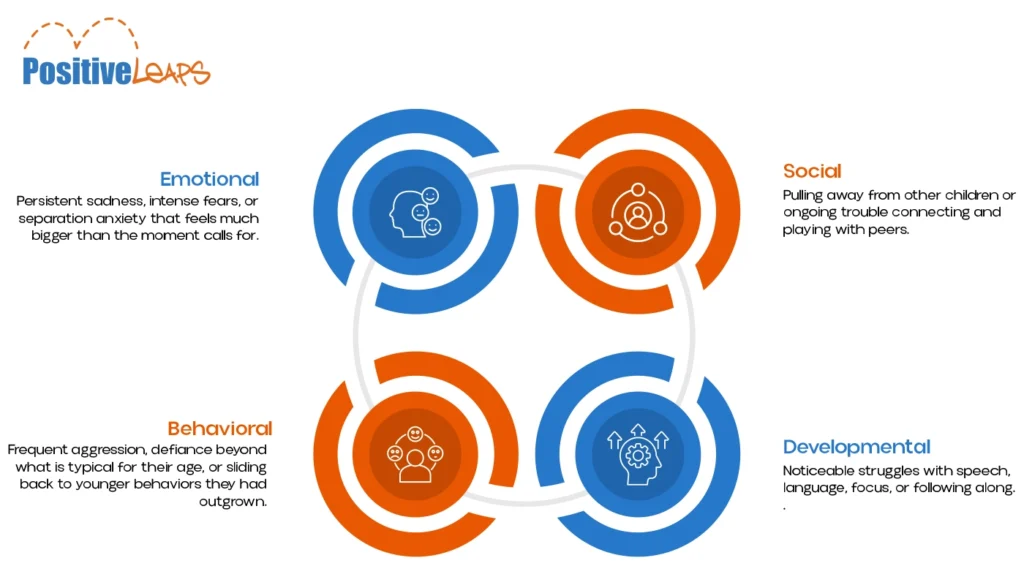
Here are some signs that may be worth a closer look:
- Emotional: Persistent sadness, intense fears, or separation anxiety that feels much bigger than the moment calls for.
- Behavioral: Frequent aggression, defiance beyond what is typical for their age, or sliding back to younger behaviors they had outgrown.
- Social: Pulling away from other children or ongoing trouble connecting and playing with peers.
- Developmental: Noticeable struggles with speech, language, focus, or following along.
One or two of these on a hard week are just part of childhood. But if you are seeing patterns that stick around, get in the way of daily life, or simply leave your gut feeling uneasy, it is okay to ask for help. When in doubt, ask. You can always start by reviewing the signs that point toward behavioral therapy or learning more about support for an aggressive child.
What Early Help Actually Looks Like
For many parents, the word “therapy” can feel intimidating, especially for someone so small. But support for young children is gentle, warm, and built around how kids naturally learn and grow.
- Play therapy. Children do not always have the words for their feelings, but they have play. Through play, a trained therapist helps a child express and work through emotions in a way that feels safe and natural to them.
- Specialized day treatment. For children who need more support, specialized day treatment offers a structured, nurturing environment where they can build emotional and social skills with consistent guidance.
- Partnering with you. You are the most important person in your child’s world, so good early support always includes you. Therapists share tools and language you can use at home, so the progress your child makes carries into everyday life.
And here is the most reassuring part: early help genuinely works. Again and again, children who receive early support move from struggling to a healthier, steadier place, and many of those gains stay with them as they grow.
How to Take the First Step
Taking the first step can feel like the hardest part, but it does not have to be complicated. It often starts with a simple conversation.
If you are in Cincinnati, Ohio, our team is here and ready to help. You can reach out to us to schedule an evaluation and talk through what your child might need. There is no pressure, just support.
Final Thoughts
It takes real courage to ask whether your child might need more support. The fact that you are here, reading and caring deeply about this, says everything about the kind of parent you are.
Please be gentle with yourself. Choosing to act early is not a sign that something has gone wrong. It is one of the most hopeful, loving choices you can make. You are giving your child a stronger foundation for everything that comes next.
And with the right support, like Positive Leaps, you can help them grow into all they are meant to be.