

It is a scene many parents know all too well: a trip to the grocery store or a playdate at the park ends in a whirlwind of screaming, kicking, or even a sudden bite. In those moments, it is natural to feel a mix of exhaustion, embarrassment, and deep concern. You might wonder, “Is this just a phase, or is something wrong?”
If you are struggling with a child who lashes out, you are not alone. Aggression in early childhood is one of the most common reasons parents seek professional support. At Positive Leaps, we understand that behind every aggressive act is a child struggling to communicate a need or an emotion that feels too big for their age.
The good news? Early childhood is the most effective time for intervention. With the right therapy for an aggressive child, these “big emotions” can be harnessed into positive social skills and self-regulation.
What Is Aggressive Behavior in Young Children?
Before diving into solutions, it is important to define what we mean by aggression. In a clinical sense, aggression refers to repeated physical or verbal behavior intended to cause harm or assert dominance.
Distinguishing Between “Normal” and “Concerning”
It is helpful to know that 50–60% of toddlers show aggression at some point in their development. According to research by Richard E. Tremblay, physical aggression peaks between ages 2 and 4. At this stage, children often lack the verbal skills to say, “I’m frustrated because you took my toy,” so they use their hands instead.
However, while most children outgrow this phase, 10–15% continue to struggle with aggression into kindergarten and beyond. This is where professional support becomes vital.
Types of Aggression
- Impulsive Aggression: This is emotion-driven. The child feels an intense “burst” of anger or frustration and reacts instantly without thinking.
- Proactive Aggression: This is goal-driven. A child might hit another child specifically to take a toy or to get a specific reaction.
Common behaviors include hitting, biting, kicking, yelling, throwing objects, and property damage. If these behaviors are frequent and intense, it may be time to look more closely at the “why.”
Why Does a Young Child Show Aggression?
Aggression is rarely “meanness.” Instead, it is usually a symptom of an underlying struggle.
Emotional Dysregulation
The prefrontal cortex, the part of the brain responsible for impulse control, does not finish developing until a person is in their mid-20s. For some children, this development is slower, or their “emotional thermostat” is more sensitive. Children with poor emotional regulation are 2–3x more likely to show aggression because they simply don’t have the “brakes” to stop an impulse once it starts.
Environmental Factors
High levels of parental stress, inconsistent discipline, or exposure to violence can increase a child’s baseline anxiety. The Adverse Childhood Experiences (ACE) Study shows that exposure to chronic stress or violence can triple the risk of aggressive behavior.
Neurodevelopmental Disorders
Sometimes, aggression is linked to how a child’s brain is wired.
- ADHD: 30–50% of children with ADHD show aggression due to high impulsivity.
- Oppositional Defiant Disorder (ODD): Characterized by a persistent pattern of anger and defiance.
- Autism Spectrum Disorder (ASD): Sensory overload or communication barriers can lead to aggressive outbursts in 25–68% of children on the spectrum.
When Should You Seek Therapy for an Aggressive Child?
Seeking therapy is a proactive step, not a sign of failure. Early intervention (ideally before age 8) significantly improves long-term outcomes in school and social life. You should consider professional help if:
- The aggression has persisted for more than six months.
- There is a high risk of injury to the child, siblings, or peers.
- The child is facing suspension or expulsion from preschool or daycare.
- The behavior is interfering with the family’s ability to function.
Research shows that early suspension is a predictor for future academic struggle, with a 5x higher risk of dropping out later in life. Addressing these behaviors now prevents them from becoming “baked-in” habits.
Get Help for Your Child
If you’re noticing these signs, it may be the time to get support. Many families in Cincinnati, OH come to us at this stage, and early help makes all the difference.
Schedule a free assessment and get a clear, personalized plan for your child.
Specialized Support at Positive Leaps

At Positive Leaps, we provide intensive, evidence-based environments designed specifically for children ages 2 to 8. We offer two primary levels of care to help children get back on track:
1. Full-Day Pediatric Day Treatment Program
For children who require more than a weekly therapy hour, our Full-Day Pediatric Day Treatment Program is a CARF-accredited program (PHP-level of care). This 8-hour per day, 5-day per week program provides a structured environment similar to a daycare but staffed by licensed mental health professionals. With a high staff-to-child ratio and daily progress updates, we help children develop positive skills within a few weeks.
2. Intensive Outpatient Program (IOP)
Our Intensive Outpatient Program (IOP) is a specialized “day treatment near you” for children aged 3 to 8. This program occurs 3 times per week for 3 hours per day. It includes weekly family therapy and parent coaching, ensuring that the progress your child makes in our clinic carries over into your home.
Which Types of Therapy Help Aggressive Children?
When you work with a specialist, they will likely use one or more of the following evidence-based approaches:
Parent-Child Interaction Therapy (PCIT)
PCIT is often considered the “gold standard” for therapy for aggressive toddlers. It involves live coaching where a therapist watches through a one-way mirror and coaches the parent via a “bug-in-the-ear” device. This helps the parent build a stronger bond with the child and learn to manage non-compliance effectively. Studies show that families report meaningful improvement within 12–20 sessions.
Cognitive Behavioral Therapy (CBT)
For children closer to school age (6–12), CBT for aggressive children is highly effective. It teaches kids to identify “red flag” feelings in their bodies and use “Stop–Think–Act” methods. Meta-analyses show a 40–60% reduction in anger-related incidents following CBT.
Play Therapy
Play is the natural language of children. In structured play therapy, a therapist uses symbolic play to help children express feelings they don’t yet have words for. It is most effective for children ages 3–10.
What Happens During a Therapy Session?
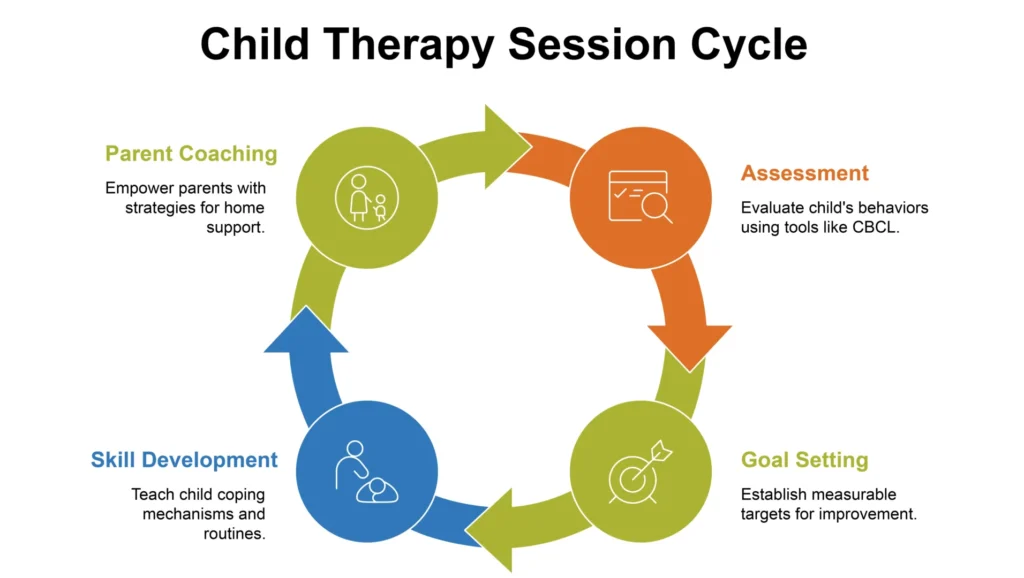
If you’ve never been to child therapy, the process is structured and transparent:
- Assessment: It involves using tools such as the Child Behavior Checklist (CBCL) to assess the frequency and intensity of behaviors.
- Goal Setting: Setting measurable targets (e.g., “Reduce hitting from 5 times a week to 1”).
- Skill Development: In this phase, the child will learn deep breathing, emotion labeling charts, and “calm-down” routines.
- Parent Coaching: This involves teaching you to use structured time-outs and behavior-tracking sheets so you feel empowered at home.
Most parents begin to see visible improvement by session 8 to 10.
How Can You Help an Aggressive Child at Home?
While therapy provides the blueprint, the real work happens in the “in-between” moments at home.
Use Labeled Praise
Instead of a general “Good job,” use labeled praise: “I like how you used your gentle hands when you were frustrated,” or “I am so proud of how you used your words to ask for that toy.” This reinforces the specific positive behavior you want to see again.
The Time-Out Rule
Consistency is key. A common rule of thumb is 1 minute of time-out per year of age. The goal isn’t punishment; it’s a “reset” for the nervous system.
Create a Calm-Down Corner
Instead of always sending a child to their room, create a “calm-down corner” with pillows, sensory toys, and visual emotion charts. This teaches the child to proactively manage their big emotions before they escalate into aggression.
Long-Term Outcomes: Why Early Action Matters
Untreated chronic aggression increases the risk of antisocial behavior in adulthood by up to four times. However, early therapy builds resilience. Children who receive support early on show:
- Better peer relationships.
- Higher academic engagement.
- Improved self-esteem.
- Stronger family bonds.
Take the First Step with Positive Leaps
If your child’s aggression feels overwhelming, remember that seeking support is a proactive step toward a more peaceful home. You don’t have to navigate this alone. At Positive Leaps, we specialize in turning behavioral challenges into opportunities for growth.
If your child is struggling to manage their big emotions, our Intensive Outpatient Program or Full-Day Day Treatment can help your child get back on track within a few weeks. Contact us today to learn more.